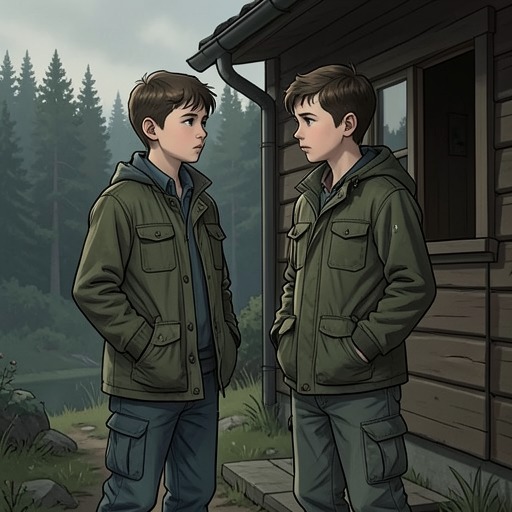
Jon and Lars Haug
Out Stealing HorsesJon and Lars Haug are joined most unmistakably in the aftermath of Odd’s death, when their familiar childhood closeness returns in a changed form. Jon takes responsibility for Lars, and the two boys share hours of silence, a first handclasp since early childhood, and the ordeal of Odd’s funeral. Their relationship is shown not through explanations of grief but through small acts of staying together when words fail.
Before and After the Gunshot
Before the shooting, Jon’s attention is on the twins as his younger brothers. He returns from hunting hares with two kills, pleased by a rare success: he has fired twice and hit twice. In his haste to show his catch to his parents, he leaves his gun in the hall and goes looking for the twins, who are meant to be in his care. He searches the house, yard, shed, barn, and riverbank before hearing a shot from the house. The details place Jon inside the chain of circumstances surrounding Odd’s death, but the narration does not make him the shooter. It is Lars who accidentally shoots his twin brother; Jon’s connection to the tragedy is that of an older boy whose ordinary responsibilities and routines are overtaken by it.
The story of the shooting reaches the reader through Trond’s recollection, which openly distinguishes the event’s uncontestable facts from the remembered scene built around them. Trond acknowledges that his father could not have supplied every detail as he remembers it. The image that remains is Jon’s white face and the rain over the river as he pushes a boat away and lets the current carry him toward home. That remembered departure gives Jon’s response a physical direction: after the gunshot, he moves back toward the people and household bound up with the loss, rather than explaining what has happened.
Care in the Hours of Waiting
After the death, Jon’s father leaves to bring the boys’ mother home from Innbygda and tells Jon to look after Lars. The instruction turns their relationship into an immediate responsibility. Jon takes Lars out in the boat to fish, unable to think of anything else to do. They are gone for hours. Trond cannot say what the boys talked about; he can only imagine that they may have stood on the bank with their rods, casting and reeling in, separated by a little distance and surrounded by forest and silence. The uncertainty matters: their companionship is real, but its language is inaccessible to the adult remembering it.
When they return, the boys go into the barn with their small catch and wait there rather than entering the house. They remain together through the long absence, with the fish offering a modest task and a reason to stay put. Late in the evening, they hear the returning cart on the road. They look at one another, apparently reluctant to end the shelter of waiting, and only then get to their feet. In this pause, Jon’s care is not expressed as consolation or advice. He stays beside Lars until they can face the family’s return together.
The boys then hold hands for the first time since the twins were quite little. The gesture marks a return to an older intimacy, but it occurs under circumstances neither boy can restore to childhood. They walk into the yard together and watch the cart approach. Their mother arrives in a blue dress patterned with yellow flowers, handbag in her lap, and greets them as she gets down. The handclasp precedes this reunion: before the household can gather again, Jon and Lars meet the moment as a pair.
At Odd’s Funeral
At the funeral, Jon and Lars occupy different but connected positions in the family’s grief. Lars cannot remain composed beside the open grave. As the little coffin is about to be lowered, he tears himself free from his mother and runs among the headstones, circling near the churchyard wall with his head down. His legs keep moving even when a neighbor catches and lifts him; he makes no sound. The scene does not turn his anguish into a speech. It makes it visible in the repeated motion of a child unable to stand still while his brother is buried.
Jon watches this distress, and his response is registered through his exchange with Trond. Trond looks over at him and gives a slight shake of the head; Jon offers no answering gesture and stares back without blinking. The moment shows Jon’s presence beside Lars’s suffering without claiming that he can interpret or ease it. The funeral’s attention shifts from the coffin to Lars as the mourners turn to watch him. Jon remains a witness to that shift, as well as to the loss that has altered the boys’ lives.
A Bond Without a Remedy
The evidence for Jon and Lars’s bond is concentrated in acts rather than declarations: Jon takes Lars fishing, waits with him in the barn, rises when he does, and holds his hand. These actions do not erase the divide opened by Odd’s death or establish that the boys recover from it. They show a brief form of mutual closeness made possible by shared presence. The boys’ silence is not evidence that grief has passed; it is the medium through which they endure the hours before their mother returns and the funeral that follows.
The account also preserves the limits of what can be known. Trond remembers scenes, gestures, and faces, while admitting uncertainty about how some details entered his memory. He imagines the boys fishing in silence, then records the handclasp and Lars’s running at the grave. Through this mixture of remembered fact and acknowledged reconstruction, Jon and Lars’s relationship appears as something witnessed from nearby but never fully explained. Its decisive expression is small and bodily: for a moment, after the death of one brother, the surviving boys hold on to each other.